|
A Cold Pool Is
Only 1/2 a Pool
Prudent use of energy resources is the key
to producing thermally efficient buildings and in this case, swimming
pools. It is more than simply providing extra heating or refrigeration; it
is primarily the need to achieve total energy balance.
For example, an Expanded Polystyrene Styrofoam (EPS) wall need only be
1/20 the thickness of a brick wall to achieve the same degree of
insulation. However, a brick wall is 2,000 times as heavy, and requires
600 times as much energy to produce.
While it is not suggested that polystyrene will replace the brick, it
highlights how EPS used in conjunction with traditional materials can be
used to provide more cost efficient building methods…and better use of
energy resources.
EPS is a product that is not only compatible with all building materials,
but offers versatility, design, ease of construction and cost advantages
that the other materials cannot.
The aware architect, engineer, and builder using EPS in practical ways,
has unlimited scope for designing more thermally efficient pools and at
the same time maintain energy balance. Some states even offer governmental
rebates for using products that save energy. That can be a great
promotional tool for a builder looking to appeal to environmentally
conscientious consumers or homeowners who want to save money on their
heating costs.
Expanded
polystyrene
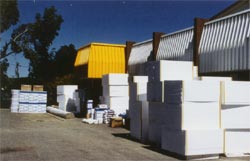 Expanded
polystyrene is a lightweight cellular plastic material consisting of fine
spherical shaped particles that are comprised of 78% air; this air is
trapped within a number of closed cells in each particle. Blocks of expanded
polystyrene are made by re-softening the expanded particles in a block
mold with steam until they fuse together. Expanded
polystyrene is a lightweight cellular plastic material consisting of fine
spherical shaped particles that are comprised of 78% air; this air is
trapped within a number of closed cells in each particle. Blocks of expanded
polystyrene are made by re-softening the expanded particles in a block
mold with steam until they fuse together.
Because stabilized air is such a good insulator, the resultant product is
extremely effective as thermal insulation material.
Thermal performance of material is measured in terms of its resistance to
the flow of heat which is expressed in R values, the higher the number,
the better the insulation. The difference is that you’ve literally
installed an R-20 insulated value wall in the ground.
 |
Lightweight and
strong |
|
|
Flexibility in design |
|
|
Thermal Insulation:
Because of the insulating properties of the therma-foam
pool wall, the cold ground does not rob the pool of its heat; heat
loss from the water to the surrounding ground is reduced and the pool
is therefore warmer than any other type of pool structure. |
|
|
Flexibility copes with movement and stress:
The therma-foam pool wall system has been designed to
withstand
free active earth movement and other pressures. |
|
|
Easy to handle and place |
|
|
Increases safety for workers |
|
|
Cost effective:
The only pool system that pays for itself
when heated. |
|
|
Non-corrosive:
Utilizes essentially inert materials, which will not
succumb to corrosion in the presence of
moisture or acidic soils. |
|
|
Durable and tough |
|
|
Environmentally Friendly
|
Floor Barrier Insulation
We are committed to offering Green Insulation Products
and other energy efficient products that will help reduce dependency upon foreign energy
products and reduce the drain on natural resources. For that reason we also offer
the floor barrier insulation product to use under concrete for a better insulated pool.
Reflective Foil Foam Radiant Barriers Stop up to 97% of Radiant Energy Transfer and much more.
It's an ALL-IN-ONE under concrete EPS insulation product used under concrete slab as insulation
by providing vapor and moisture barrier protection in combination with insulation from conduction.
It works better, is cost effective, and easy to use. It is a vapor/moisture/insulator and radon
protector. The Barrier is a rolled foam board insulation of extruded expanded flexible recycled
polystyrene foam (XPS).
The floor barrier is a 100% vapor, water, moisture barrier as well as a thermal break of conductive
heat transfer and radon resistor all in one product. It uses an extruded XPS with laminated heavy-duty
polyethylene film on both sides: it stops 100% of any and all forms of moisture transfer, try that with rigid
foam sheets. The multi-layer product's make up is an effective radon retarder and when proper sealing
and gas infiltration procedures are used, the insulation floor barrier blocks the radon transmission.
Radon gas is the 2nd leading cause of Lung Cancer and builders should be aware that this product is a RADON
Protector for their customers. Termites also are deterred by the naturally occurring boron in the Barrier.
Roll sizes are 4 x 60 = 240 sq ft per roll. In addition to the high performance characteristics and standards
the Barrier is setting for the underground insulation/under concrete insulation market, it has the patented
self-sealing double faced taped edges.
This product is optional and recommended for cooler/cold climates. The floor insulation is available
in the following thicknesses:
3/8" - used in cooler, cold climates
3/4" - used in colder climates
1-1/4" - used in extreme cold climates
|